Bicycling remains one of San Francisco’s most popular ways to navigate the city’s busy streets. However, accidents involving cyclists are not uncommon, raising important questions about how fault is established after a collision. Understanding the legal process behind these cases is key for cyclists who want to protect their rights and pursue fair compensation. If you are involved in a bicycle accident and need advice, you should get legal help to ensure your interests are represented from the start.
San Francisco’s roads present unique risks for cyclists. Determining fault goes beyond who collided with whom, as courts and insurance companies consider a mix of evidence and specific local laws. In many cases, multiple parties may share responsibility, so having knowledge of these nuances often shapes the outcome of accident claims.
Establishing fault is crucial because California follows a comparative fault system. This system allows more than one person to be found partly responsible for a crash. As a result, the allocation of fault directly affects the settlement or judgment amounts that each party may recover or owe. Thorough documentation and early legal intervention can help clarify the events and preserve key evidence, thereby strengthening a cyclist’s case for compensation.
Key Factors in Determining Fault
Assigning responsibility in a bicycle accident involves careful consideration of the facts. Factors such as road conditions, compliance with traffic signals, and whether either party was distracted or impaired at the time of the crash are examined closely. Police reports and witness accounts often help piece together what happened. In San Francisco, unique road infrastructure or the absence thereof can complicate the process, as can the city’s dense urban layout.
California Law and Bicycle Accidents
California Vehicle Code has several provisions specifically addressing the rights and duties of cyclists. Bicyclists have a right to share the road but are also required to follow traffic laws, just as motor vehicle operators do. Violations, such as running a red light or failing to signal, can affect a cyclist’s share of fault. Conversely, motorists are expected to yield to cyclists where appropriate and exercise caution, particularly in bike lanes or at intersections.
Types of Evidence Used to Prove Fault
Building a strong case often hinges on collecting persuasive evidence. Common types include photos of the accident scene, dashcam or surveillance footage, physical evidence from the bicycle or vehicle, and statements from bystanders. In more serious cases, accident reconstruction experts might be called upon to analyze how the incident occurred. Medical records also play a critical role in linking the accident to a rider’s injuries.
Common Scenarios Unique to San Francisco
San Francisco’s landscape presents hazards like cable car tracks, steep hills, and crowded intersections. Collisions involving “dooring” (when a car occupant opens a door into a cyclist’s path), rideshare pickups and drop-offs in bike lanes, and left-turn accidents are common examples that complicate fault determination. Legal professionals familiar with local patterns know how to approach these cases and what resources may best support a claim.
Comparative Fault and Shared Responsibility
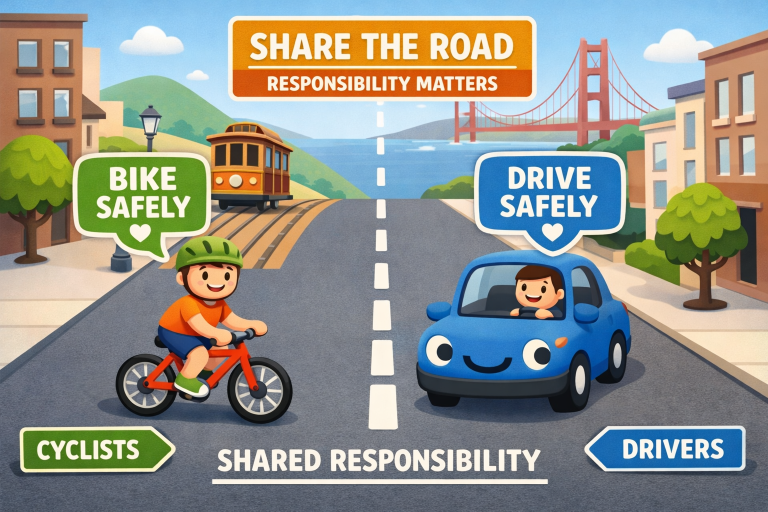
California’s comparative fault rule means that even if a cyclist is partially at fault, they may still recover damages. However, their compensation will be reduced by the percentage of fault attributable to them. For instance, if a cyclist is found 30 percent responsible for the crash and the driver is 70 percent responsible, the cyclist can recover 70 percent of the assessed damages. This system highlights the importance of clear, objective evidence in maximizing a claimant’s potential recovery.
The Role of Insurance Companies
Insurance adjusters review available evidence and may conduct their own investigations. Their aim is often to minimize payouts, making it crucial for cyclists to understand the process and what to expect. Adjusters might try to assign more fault to a cyclist to reduce liability. For this reason, prompt legal assistance can help challenge unfair assumptions or incomplete investigations.
What To Do After a Bicycle Accident
If you are involved in a bicycle accident in San Francisco, prioritize safety and medical care first. Report the accident to local authorities and seek immediate treatment for any injuries. Collect contact and insurance information from involved parties, take photographs, and gather witness contact details. Keep all documented expenses and correspondence, as these can form the foundation of your claim.
Final Thoughts
Determining fault in a San Francisco bicycle accident case is a complex but critical process. It requires a solid understanding of California law, a clear strategy for collecting evidence, and timely professional intervention. Bicyclists who are well-informed and proactive are far better positioned to secure a fair evaluation of their accident and protect their rights throughout the claims process. By staying aware of local risks and seeking expert guidance, cyclists can ride with greater confidence and peace of mind.


