Introduction
As urban areas continue to expand, durable asphalt surfaces play a fundamental role in transportation infrastructure. Yet, the methods we use to construct and maintain roads can have lasting environmental implications. Forward-thinking contractors, engineers, and property managers are now seeking innovative ways to minimize the ecological footprint of paving while optimizing surface resilience and safety. Early adoption of sustainable practices helps communities enjoy improved road quality and reduced costs over time. For anyone considering parking lot paving La Porte, IN, integrating such approaches is quickly becoming best practice.
Traditional asphalt relies heavily on petroleum-based products, and its production generates substantial greenhouse gas emissions. Shifting to greener alternatives and advanced technologies doesn’t just benefit the environment it substantially prolongs the life and performance of roads and parking lots. This article explains how incorporating these sustainable methods is reshaping the paving industry and offers a roadmap for building more resilient infrastructure.
Municipalities, developers, and business owners who champion these sustainable improvements often achieve long-term savings and increased public safety. Enhanced asphalt mix designs and smarter stormwater management reduce the need for frequent repairs, improve skid resistance, and minimize disruption for communities and businesses. These investments align with both economic and environmental stewardship, ensuring that the benefits extend well beyond the construction phase.
Cutting-edge approaches, including recycled materials, green binders, and advanced technologies, are gaining traction across North America and globally. Governments and industry leaders are also setting higher standards for road durability and environmental responsibility. By adopting these forward-thinking practices now, contractors and facility owners position themselves at the forefront of modern infrastructure trends.
Algae-Based Binders: A Green Solution
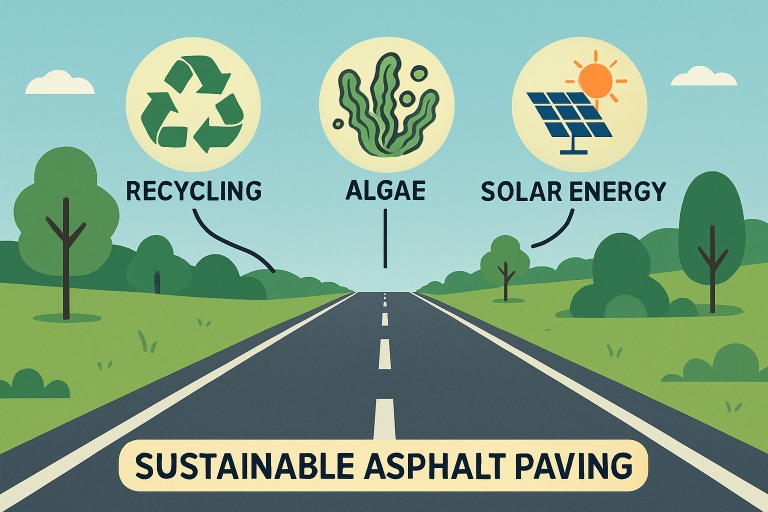
One of the most promising advances in eco-friendly asphalt production is the use of algae-based binders. Algae, a rapidly renewable resource, can be converted into a binding agent that largely replaces petroleum in traditional asphalt mixes. This innovation not only reduces reliance on fossil fuels but also improves flexibility and temperature tolerance qualities highly valued in regions with severe weather variability.
Laboratory and field studies show that algae-derived binders enhance pavement performance, especially in terms of resistance to cracking and rutting. These pavements last longer and require fewer repairs, resulting in both cost and carbon savings. Early installation projects have set benchmarks that pave the way for more commercial-scale adoption of this transformative technology.
Incorporating Recycled Materials
Asphalt is one of the most recycled materials in the world. Integrating recycled asphalt pavement (RAP) and products such as crushed glass, metals, and waste tire rubber helps reduce landfill burden and conserve limited natural resources. This practice significantly reduces demand for raw, energy-intensive materials such as virgin aggregates and traditional binders.
RAP and supplementary recycled materials are shown to provide durability equal to or superior to that of conventional mixes when appropriately engineered. This results in lower lifecycle costs, improved resistance to moisture and wear, and a substantial reduction in overall environmental impact. For those managing large commercial parking lots or city streets, leveraging recycled content is both fiscally and environmentally responsible.
Warm Mix Asphalt Technology
Warm-mix asphalt (WMA) marks another leap forward in sustainable road construction. Produced and applied at significantly lower temperatures than hot-mix asphalt, WMA technology offers a dual win for environmental quality and workplace safety. Lower production temperatures mean less energy use and lower greenhouse gas emissions. Furthermore, WMA enhances working conditions for paving crews by reducing exposure to hot fumes and enabling longer haul distances, thereby supporting more efficient project coordination. The widespread adoption of WMA is anticipated to revolutionize paving norms, especially in urban regions aiming to reduce their carbon footprint.
Permeable Pavements for Stormwater Management
Modern infrastructure must manage rainwater responsibly, and permeable pavements offer a proven solution. Unlike conventional impervious surfaces, permeable asphalt is engineered with an open-graded structure that allows water to seep through. This reduces stormwater runoff and facilitates natural groundwater recharge, helping communities deal with heavy rainfall and mitigating the risk of local flooding.
This technology also supports compliance with stormwater regulations, reduces surface pollutants, and helps keep nearby waterways clean. These benefits not only protect the environment but also boost property value and prevent costly damage. Incorporating permeable surfaces into parking lots and low-traffic roads has become a best practice in sustainable urban design, as Stormwater Solutions reported on New York City’s permeable pavement initiatives.
Energy-Harvesting Roadways
Emerging technologies are turning the roadways themselves into energy sources. By embedding piezoelectric materials within the pavement, engineers have developed roads that generate electricity from the pressure of passing vehicles. These energy-harvesting surfaces can power streetlights or integrate into local grids, presenting exciting opportunities for smart cities and sustainable infrastructure initiatives.
While these systems are still in the early stages of deployment, pilot projects across Europe and Asia indicate that this innovation could become a mainstream solution for offsetting the energy requirements of road networks. The added value generated by roads that generate power supports a holistic approach to urban sustainability and infrastructure resilience.
Enhancing Durability with Advanced Materials
Pushing the boundaries of road longevity, advanced asphalt materials such as polymer-modified binders and synthetic waxes deliver unmatched flexibility and moisture resistance. These mixes are engineered to withstand extreme weather, heavy traffic, and intense freeze-thaw cycles, pushing maintenance intervals further apart than ever before.
By improving the structural integrity and adaptability of pavements, these specialty materials help municipalities and private owners protect their assets for decades. The result is infrastructure that stands up better to both environmental and day-to-day challenges, lowering the total cost of ownership and supporting long-term community growth.
Conclusion
By integrating sustainable practices from algae-based binders and recycled materials to innovative technologies and advanced materials, communities and businesses can realize longer-lasting, safer, and more environmentally responsible asphalt surfaces. These innovations not only deliver immediate eco-friendly wins but also lay the foundation for cost-effective, resilient infrastructure that supports future urban growth and the stewardship of natural resources. Modernizing road construction through sustainable solutions is no longer an option; it’s the new standard for forward-thinking development.